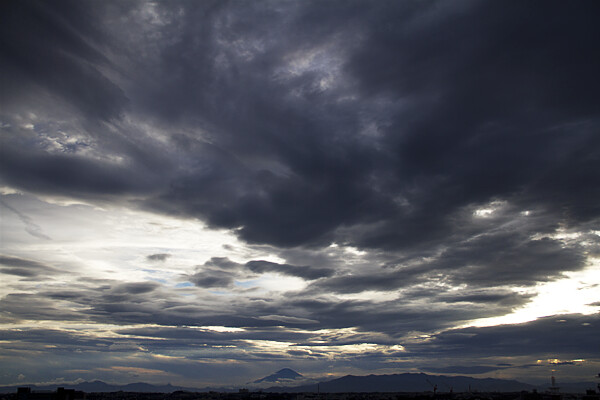
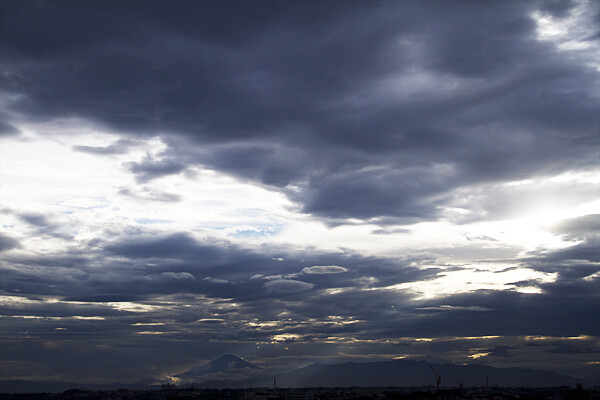
| There are two views from our Yokohama apartment that I love–the big cloudscaped skies and the symmetrical silhouette of the distant Mount Fuji. And sometimes, on certain evenings in certain light, the two come together and the result is spectacular. |
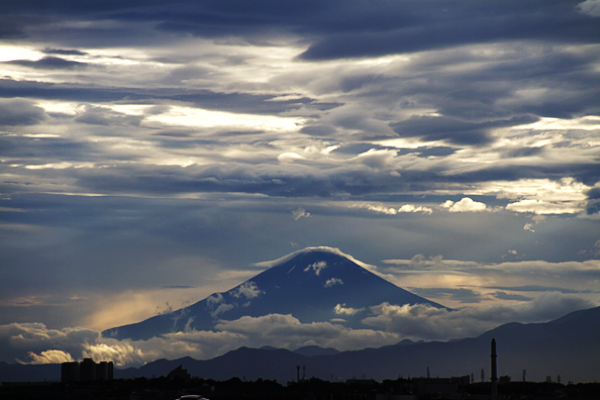
| There are two views from our Yokohama apartment that I love–the big cloudscaped skies and the symmetrical silhouette of the distant Mount Fuji. And sometimes, on certain evenings in certain light, the two come together and the result is spectacular. |
Asakusa (Tokyo), Japan. May 2014.


|
There’s a writing exercise I use with my students where I give them an image–usually something clipped from a magazine–and tell them to write about what they see for a set period of time. Then I give them a blank sheet of card-stock paper with a small square cut out of it. I tell them to put the card-stock over their image and move it around until it reveals some interesting detail, then write only about that smaller part of the image for the same amount of time. Often they write completely different stories or poems, about completely different things and from completely different perspectives. And yet, when you pull back, sometimes it’s difficult to see that all those stories are happening simultaneously. It’s not really surprising then, that this is also a pretty important idea in photography. In many ways, the art of photography is the art of cropping. We use our cameras to crop the visible world down to the frame within the lens. Once we’ve taken the photograph, we can crop hundreds of different stories from the same frozen moment by shifting our attention and narrowing or expanding our frame to suit. How does the story of hands on a smartphone change if we are also given a glimpse of the face that is using it? What if we only see part of the face that’s using it–lips slightly parted in what? exasperation, exclamation, desperation, wonder? How important is the story of that phone if we move it to the side of the frame and centre on a woman in a jean-jacket or a man piggy-backing his boy and carrying a folded stroller? Each of these images is cropped from the same image (below). Which story is the most compelling to you? |

Yokohama, Japan. May 10, 2014.


|
Some days are for walking. It happens that two of my closest friends were born on the same day, a year apart. Seems like a grand coincidence to me, though I’m sure the astrologers would say that it makes perfect sense. Every year, when their birthday comes around, I try to spend at least part of the day walking, taking pictures of what their birthday would look like if they could spend it with me, since I am so very rarely able to spend it with either of them. This year, their birthdays fell on a Saturday, a day without obligations, a day I could spend as it chose to unfold, the kind of day that is best spent with friends. Is it odd that thinking of far away friends can make you more present where you are? Some of the very best things are odd. |

Tokyo, Japan. May 2014.

|
Sometimes we forget to be tourists in the places we live. Having visitors helps. On this occasion, we ventured into Ginza, headed for the Laduree Tea Room, but arrived too early and had to wait outside a bit before we could go in. The waiting was exceptional, as the day was clear and temperate and given to people-watching. I took this photograph in the window of a department store. A line of brightly coloured pedestrians makes its way through the monochrome of sand-dune beach-brush, a black-and-white couple sits on steps imagined from the crosswalk zebra and a spectrum of silver sand spills out into the city streets under facades of glass and brick and the signage of the city while an icon of fashion turns the other cheek. Even as the spring becomes the summer, it’s all about the layers. |
Daikanyama, Tokyo, Japan. September, 2013.


Yokohama, Japan. September 2013.


|
As is turns out, we slept through typhoon 26 in the safety of our well-engineered apartment tower. We woke in the morning to clear blue skies. On the right, a brilliant rainbow sprouted from the cloud-capped shoulder of Mt. Fuji. On the left, a daunting wall of grey rain and clouds hovered over the bay. I wasn’t sure if we had missed the typhoon or if it was just about to arrive. Before long, we learned that the worst of the storm passed through a couple of hours earlier, between 5 and 6 am, leaving only the uncommonly clear skies of an atmosphere scrubbed zealously clean. But elsewhere in Japan, Typhoon 26 caused landslides that killed at least 17 people. It is a strange and heavy thing, to sleep restfully through something others will never awake from. These are the last photos from after Typhoon 18, the ones that I took with my regular camera. The wake of the storm, the day laid to rest. |
Yokohama, Japan. September 2013.


|
We are expecting a typhoon tomorrow. Typhoon Wipha, number 26. A big one. A once-in-ten-years kind of blow-down throw-down. Apparently the last time a storm of this magnitude came through, they had to pick up the front gate of our school down the street from the parking lot of the gymnasium. School has been cancelled, we bought some groceries and are battened down for the night. There was another typhoon, number 18, in September. In its wake, the particulates of industry were washed out of the air, nature’s version of high-definition clarity. The windows were covered in dried-in-place drops of salt sea-brine, and as the sun set, the colors lit up a cloud-painted sky. |
Yokohama, Japan. April 2012.


|
This is how we go. To move in Yokohama is to go over or under; it is a city of overpasses and underpasses, of foot bridges and elevated highways and subway trains. Much of the city is built of land reclaimed from the sea, seamed together with waterways and canals under a network of pathways held up in the air by riveted pillars and boxy beams, a strangely graceful curvature of concrete and metal woven into a future as it was imagined in the industrial age. Over and under we go. |
Kamakura, Japan. April 2011.

| One more bicycle before summer ends. I took this one a couple of years ago, meant to post it and never quite got around to it. It encapsulates something quintessentially Japan for me. It’s not a place of big supermarkets and concrete-block malls—there are big supermarkets, don’t get me wrong, but there is still very much a culture of locally owned shops and services. Instead of pulling the family SUV into the superstore lot, for the most part in Japan, you can pedal a bike to the bakery or the or the fruit seller and buy what you need put it in the handlebar basket and pedal home. In spite of the surrounding metropolis, it seems to keep life on a livable scale. |
Kamakura, Japan. April 2011.

 The Puddlewonder Press